Dissertation study 2 · Mechatronics & control
Vision-guided multi-servo nozzle spot spraying
A complete perception-to-actuation prototype that converts weed coordinates into nozzle assignments, steering angles, timing compensation, and sequential spray commands.
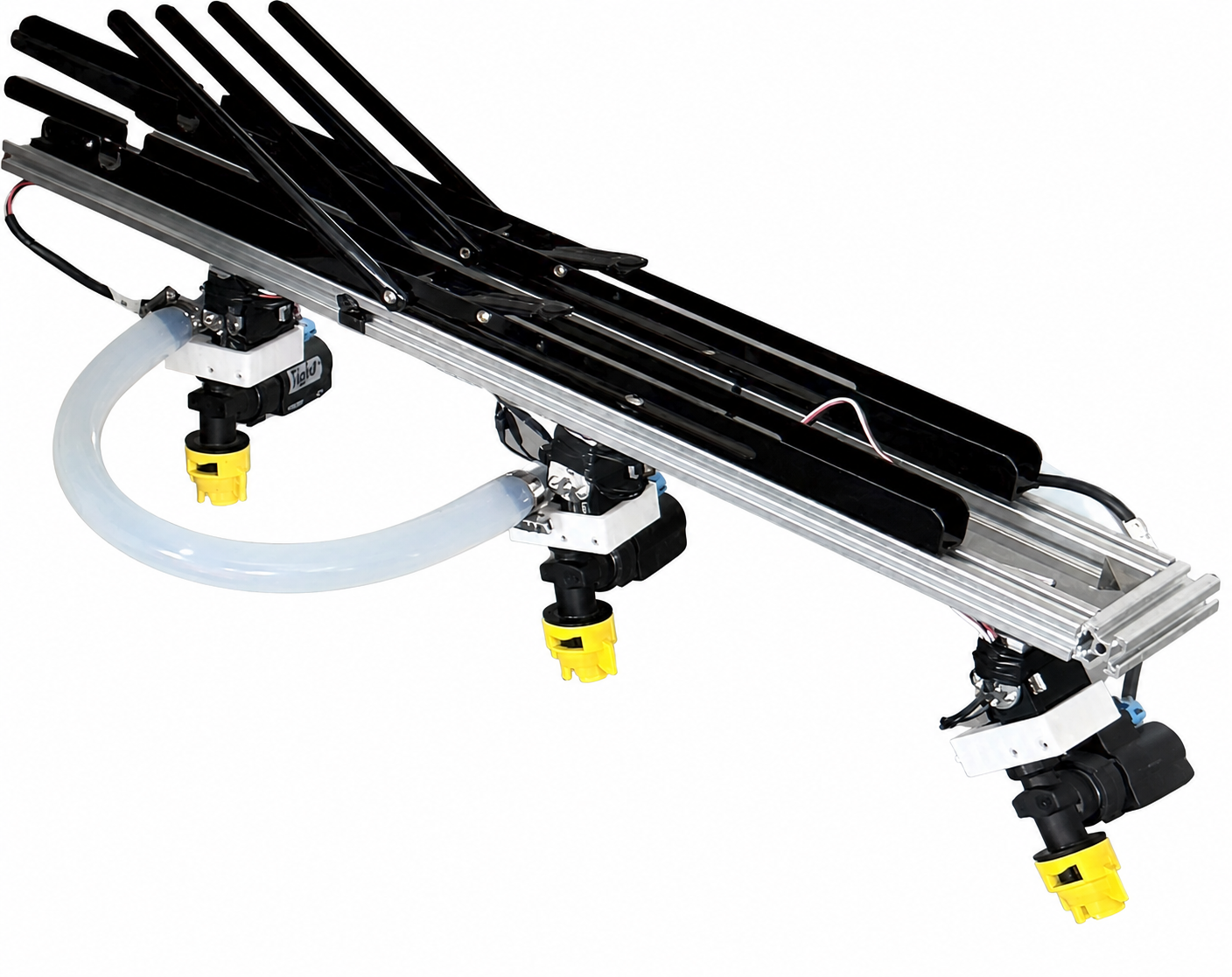
PlatformHusky A200
NozzlesThree servo-steered
SteeringUp to ±35° evaluated
ControlVision + timing + ACO
Research challenge
Weeds occur at irregular lateral positions near trunks, where fixed nozzles may miss targets or expose non-target tree tissue.
Engineering approach
- 01Calibrate pixel-to-ground mapping and camera-to-nozzle offset.
- 02Assign targets to three nozzle zones and compute steering commands.
- 03Use rule-based logic and ant colony optimization for conflicts and scheduling.
- 04Evaluate servo response, hit accuracy, and water-sensitive-paper coverage.
Measured performance
Systems in action
Laboratory performance and servo validation
These demonstrations show the complete laboratory system operating as a coordinated unit and isolate the multi-nozzle steering mechanism for direct validation of servo response and spray-bar motion.
The moving robotic platform, live perception interface, target zones, system logs, and spray execution are shown operating together under controlled laboratory conditions.
Independent nozzle movement demonstrates the steering range and coordinated mechanical response used to direct spray toward laterally distributed weed targets.
Why it matters