Dissertation study 4 · Systems integration
Autonomous orchard navigation and targeted application
Integrating sensing, navigation, weed perception, and spray control on a Farm-ng Amiga for orchard field testing.
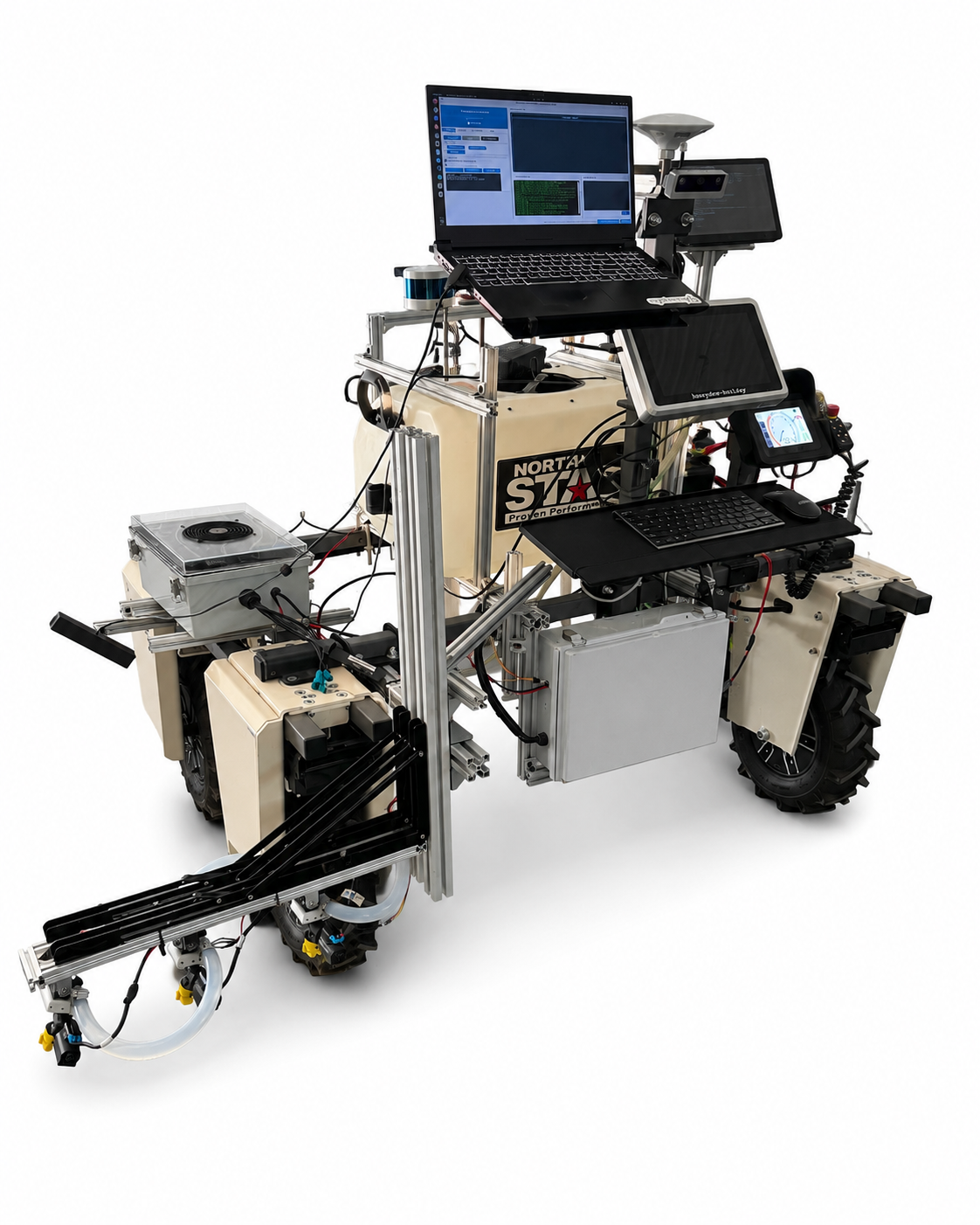
Current robotFarm-ng Amiga
ComputeNVIDIA Jetson
MiddlewareROS 2 Humble
SensingStereo vision · LiDAR · IMU
Research challenge
A laboratory spraying mechanism becomes useful only when the entire system can navigate, localize, decide, and act reliably in variable orchard conditions.
Engineering approach
- 01Fuse wheel odometry, IMU, and LiDAR for orchard-row navigation.
- 02Deploy stereo-vision weed perception on the onboard GPU.
- 03Compensate for vehicle motion and camera-to-nozzle travel time.
- 04Evaluate navigation, spray targeting, reliability, and recovery across orchard conditions.
System configuration
Systems in action
Integrated field-system performance
These field demonstrations show the mobile precision-spraying system operating beside orchard trees, connecting platform motion, weed-row positioning, and the multi-nozzle application hardware under real field conditions.
Orchard footage showing the robotic platform and nozzle assembly positioned along the tree row.
Quantifying spray performance: water-sensitive papers placed at weed targets record spray deposition, allowing target hits and coverage to be assessed during orchard-row operation.
Observed field operation
- Continuous orchard-row operation
- The integrated platform moved through the apple row under realistic field conditions.
- Stable intra-row alignment
- The servo-nozzle assembly remained positioned over the intra-row treatment strip.
- Clearance near trunks
- The prototype passed close to tree trunks without visible mechanical interference.
Why it matters